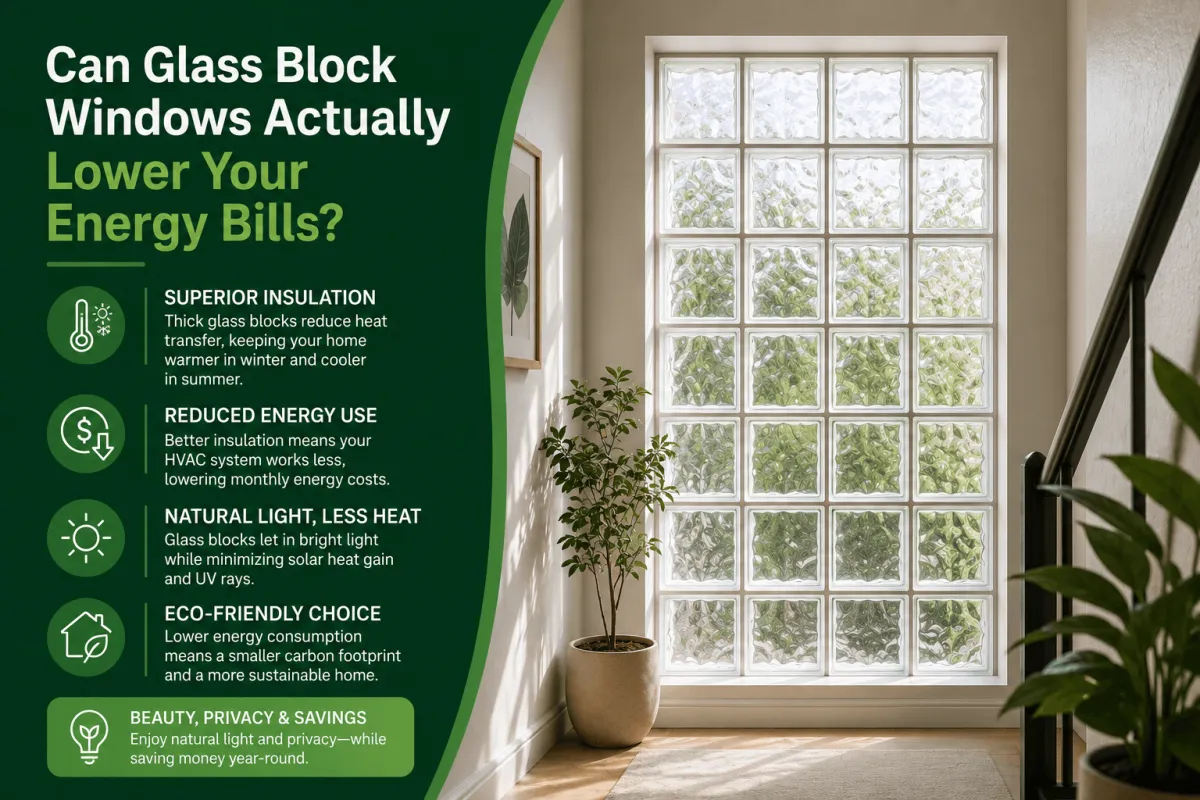
Can Glass Block Windows Actually Lower Your Energy Bills?
Energy efficiency is one of those selling points attached to almost every home improvement product. But glass block windows have a specific set of physical characteristics that genuinely affect how heat moves through your walls -- and not always in the ways homeowners expect. Rather than accepting a generic claim at face value, it is worth examining what the evidence actually says about how glass block performs on thermal resistance and air sealing compared to the windows it typically replaces.
Glass block windows are not rated the same way as modern double-pane insulated glass units. They do not carry ENERGY STAR certifications or the U-factor ratings that premium vinyl windows achieve. But that framing misses an important piece of context: glass block windows are almost always replacing something far worse -- single-pane metal-frame hopper windows, deteriorated wood frames, or openings with gaps that were never properly sealed to begin with. Compared to what they actually replace, the energy improvement from glass block is often substantial and immediately noticeable.
The Thermal Performance of Glass Block
A standard glass block unit has a U-factor -- a measure of how readily it transfers heat -- that typically falls between 0.48 and 0.60. That is not as efficient as a modern triple-pane window, but it is meaningfully better than single-pane glass and significantly better than a corroded metal frame with air gaps around the edges. The mortar or silicone surround that sets the blocks in place also creates a continuous sealed barrier around the panel, eliminating the air leakage that is frequently the single biggest energy drain in old window openings.
For most homeowners in Columbus, Ohio making the switch from old basement hoppers to glass block, the relevant comparison is not glass block versus a premium new window. It is glass block versus the deteriorated unit it is replacing. On that comparison, glass block wins clearly across virtually every energy-related performance category that matters at the foundation level.
Air Infiltration: Where the Real Savings Come From
The most significant energy impact of glass block windows is often not the thermal resistance of the glass itself, but the elimination of air infiltration. Old basement windows and hopper frames typically allow substantial outside air to pass through frame gaps, failed seals, and rusted joints. In Columbus, Ohio winters, that infiltration drives heating costs up meaningfully -- cold air leaking in at foundation level is one of the hardest energy losses to offset through heating alone.
Glass block panels, when properly installed and mortared, create a fully sealed opening with no moveable parts and no gaps. That means no outside air entering during a January cold snap and no conditioned air escaping during July. For Columbus, Ohio homeowners who heat a basement or finished lower level, eliminating air infiltration through basement window openings represents a real and measurable reduction in monthly energy costs over time.
Glass Block vs. Old Basement Windows: A Direct Comparison
The table below compares the key energy-related characteristics of old single-pane hopper windows against properly installed glass block panels.
Realistic Expectations for Homeowners in Columbus, Ohio
No window replacement should be sold purely as an energy savings product. The actual dollar amount saved depends on how poor your current windows are, how well your basement is insulated in other areas, and your current energy rates. For Columbus, Ohio homeowners dealing with drafty basement hoppers or frames deteriorating after decades of freeze-thaw cycling, the improvement in comfort is often perceptible before the next utility bill even arrives.
What glass block reliably delivers is air sealing, moisture control, and the elimination of cold drafts -- three outcomes that directly affect how comfortable your home feels and how hard your HVAC system works to maintain target temperatures. For most Columbus, Ohio homeowners replacing old basement windows, those are the genuine energy benefits of glass block, and they add up to real improvements in comfort and real reductions in energy costs over a full heating season.
Frequently Asked Questions
Do glass block windows qualify for federal energy efficiency tax credits?
Tax credit eligibility depends on the specific program in place and the energy performance ratings of the window product. Because glass block windows do not typically carry ENERGY STAR certification, they may not qualify for all available efficiency credits. Consult a tax professional or check current IRS guidance for the most accurate information applicable to your situation.
Can vented glass block panels still be energy efficient?
Vented glass block panels include a small operable vent unit, which does introduce a point of reduced insulation performance relative to a fully sealed panel. However, because the vent occupies only a small portion of the total panel area, the overall energy performance of a vented glass block installation remains significantly better than a comparable standard single-pane hopper window.
Does the pattern or finish of the glass block affect solar heat gain?
Pattern and finish do affect how much light and heat pass through the block. Clear or lightly textured blocks transmit more light and solar heat than heavily frosted or solid obscure patterns. For south-facing applications where solar heat gain is a concern, choosing a more opaque block pattern can help manage the amount of solar energy entering the space during warm months.
How does glass block perform during a hot Columbus summer?
Glass block performs well in heat primarily because it lacks the air infiltration pathways of a standard frame window. In summer, the absence of gaps around the frame means conditioned air stays inside more effectively. The block itself does absorb and radiate some heat, but for below-grade basement applications with limited direct sun exposure, this is generally a minor factor.
Are insulated glass block options available for better thermal performance?
Some manufacturers produce glass block units with insulating features, such as hollow cores or gas-filled cavities, that improve the thermal performance of the individual block. These specialty options are generally available at a higher cost per unit than standard blocks. If maximizing thermal performance is a priority for your specific project, ask your installer about which options are available and appropriate for your openings.
Final Thoughts
Glass block windows will not match the laboratory ratings of a premium triple-pane unit, but they consistently and significantly outperform the old windows they are replacing -- especially on air sealing and moisture control. For Columbus, Ohio homeowners dealing with deteriorated basement hoppers, that performance gap translates directly into improved comfort and lower heating costs. The Glass Block Warehouse has been installing energy-smart glass block solutions across Columbus, Ohio since 1987. Contact us for a free estimate and see what the upgrade would look like for your home.
